


.png)
Everyone Wants to Be Original But Keeps Copying Each Other.

There is something quietly radical about hearing one of the most celebrated creative directors in fashion admit that he thought he had finally "cracked the formula." Not because he was wrong, but because we've all been taught to believe that finding the formula is the goal.
More than ever we are obsessed with systems. There is a blueprint for everything now; how to build a personal brand, how to write a bestseller, how to make a viral reel, how to launch a business, and even how to become a successful creative. Meaning, wake up at 5 a.m., drink mushroom coffee (whatever that is, I am sticking to my oatmilk latte, thank you very much), journal for exactly seven minutes, and somehow become the next Steve Jobs before breakfast.
So when Daniel Roseberry opened Schiaparelli Haute Couture Fall/Winter 2026–2027 with a confession rather than a victory lap, it felt surprisingly countercultural.
"I thought: I've cracked the formula."After what he described as a breakthrough collection last season, he assumed creativity could be reproduced. Visit somewhere inspiring. Experience something transcendent. return home. Create.
Instead, nothing happened. Which, as every creative knows, is usually when the existential crisis begins.
"In trying to control the creative process... I stifled not only myself, but the work."Perhaps that is the most important sentence in the entire collection.
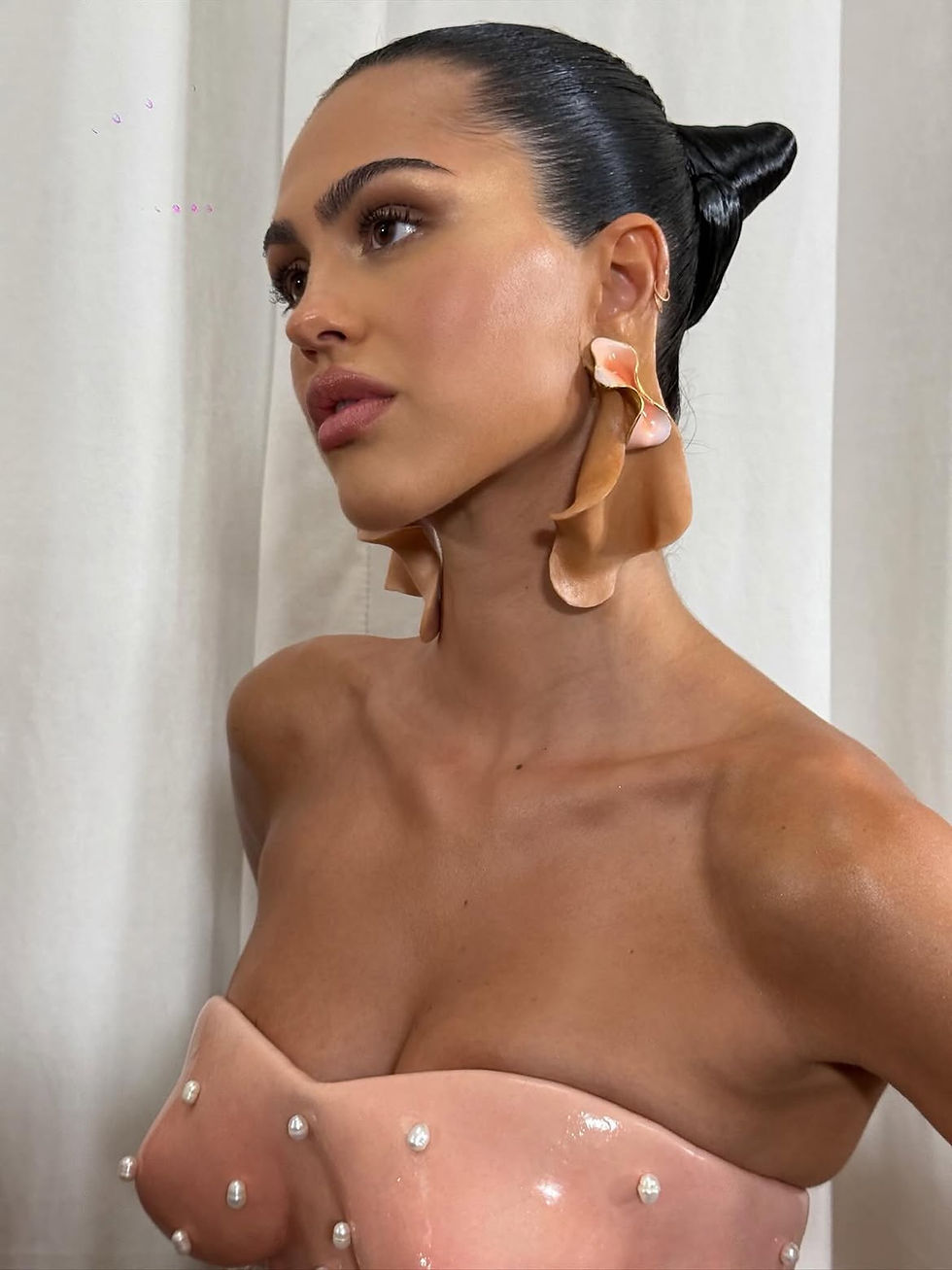
Because The Abyss is not really about latex instead of silk, or silicone replacing satin. Those are the visual manifestations of a much larger idea. The real collection is the manifesto hidden underneath the garments: that creativity cannot survive once it becomes predictable.
Roseberry writes,
"Formulas are antithetical to the magic of creation, which can be found only in total surrender to the unknown."It's a sentence that feels almost rebellious in 2026. Our culture no longer rewards surrender, rather it rewards certainty. We celebrate consistency over experimentation, familiarity over risk, replication over reinvention. The algorithm does not ask whether something is genuinely original. It asks whether it resembles something that has already performed well.
Apparently even originality now has to provide references. Perhaps that's why so much of modern culture feels strangely familiar. Hollywood remakes its own classics. Fashion revives decades before inventing new ones. Streaming platforms rely on proven intellectual property. Social media teaches creators to repeat the same video that worked yesterday because originality is harder to quantify than repetition. If your last Reel got two million views, congratulations you've accidentally become an employee of your own content.
We have mistaken consistency for creativity. Ironically, this obsession with formulas has arrived at exactly the moment artificial intelligence entered the creative conversation. The dominant fear has been that AI will replace artists, writers and designers. But Roseberry's collection quietly suggests something else.
Perhaps the greatest threat to creativity isn't artificial intelligence, but perhaps it's predictable intelligence. The belief that every creative process can be mapped, measured and repeated until it produces identical outcomes. The irony is that The Abyss itself rejects this logic at every level. Instead of celebrating traditional couture materials, Roseberry deliberately chose latex, silicone and sheets of baked paint. Not because silicone is inherently more beautiful than silk, but because the collection asks a deeper question:
"Does beauty reside in the material itself—or in the imagination capable of reinventing it?"It is one of the most fascinating questions posed on a runway in years, in actuality, it isn't really asking about couture, no It's asking about value. We increasingly confuse expensive with meaningful, traditional with superior, established with innovative. As though silk is automatically more imaginative than silicone simply because it's been around longer. By that logic, fax machines should be making a comeback.
Yet history has always shown that revolutions rarely emerge from the accepted materials, rather in my opinion, they emerge from people willing to imagine different possibilities. And imagination has always required uncertainty.
Roseberry references the French expression l'appel du vide; the call of the void. Usually associated with the strange feeling of standing at the edge of a cliff and imagining stepping forward, he reimagines it as a creative philosophy. Not a desire for destruction, but an invitation to let go of certainty. In other words, the abyss is not where creativity dies. It's where it begins.
Perhaps that is why his manifesto resonates far beyond fashion. You don't have to own a couture gown or know how to pronounce Schiaparelli without panicking, to recognise the feeling he's describing. It speaks to every creative who has ever believed they needed another course, another strategy, another productivity system before they were ready to make something. And believe when I say this; you don't.
There is another sentence in Roseberry's manifesto that deserves equal attention.
"Couture's greatest luxury isn't its materiality, but the hands that make it."In a moment when technology dominates nearly every creative conversation, it feels quietly revolutionary to remind us that luxury has never truly been about objects; It's about people. The future, Roseberry suggests, will not be decided by the materials we use. It will be decided by what human beings dare to imagine with them.
That to me is Elsa Schiaparelli's real legacy. Not surrealist symbols, gilded anatomy or impossible silhouettes, but the belief that impossibility itself can become a creative method. There is something deeply hopeful about that. Because the pressure on creatives today isn't simply to create. It's to create while remaining visible, relevant, productive and commercially successful. Preferably before you're thirty. Ideally while documenting the process in a way that's somehow authentic but also algorithmically efficient.
We have built an entire economy around eliminating uncertainty, yet uncertainty has always been the birthplace of original thought. Maybe that's why The Abyss feels so culturally significant. Not because Schiaparelli challenged what couture can be made from, but because it challenged the far more dangerous assumption that creativity can ever become comfortable. Creativity has never lived in certainty. It lives in discomfort, in doubt, in experimentation, in the terrifying possibility that what you're making might not work. Guess what? No one who was comfortable ever changed culture.


Comments