


.png)
Stop Romanticising Your First Love...
- Svetlana Berg
- 1 day ago
- 4 min read

In an era of situationships, casual encounters, and the constant pressure between “getting married quickly” and “not getting married at all,” it sometimes feels like the conversation about first love has quietly disappeared. As if it has become something outdated, almost irrelevant; something we've outgrown. And yet, sometimes, to understand who we are becoming, we have to look back. We have to remember what it was like to love for the very first time.
When you're fifteen and fall in love with a boy from school; usually an older student, a bad boy, or simply someone unattainable, it feels like this is it. Your first love. Sometimes it is. Sometimes it isn't.
In my case, my first love happened when I was seventeen, probably one of the most magical ages. You're waiting for eighteen, imagining the adult life you've read about in books and watched in films. It feels as though everything important is about to begin. The world hasn't disappointed you yet, and your heart already wants to experience everything all at once.
For everyone, first love looks different, and there is no right answer. It can be someone you've only seen a few times. It can be your first relationship. Your best friend. A neighbour. A boy who smiled at you in an airport and somehow stayed in your memory forever.
There is no single script for first love. But it almost always has one thing in common: it arrives before we've learned how to protect ourselves from our own feelings. What, really, is first love? How does it shape the relationships that come after it? Can we avoid the pain that comes with it, or is that simply part of the package?
When I was twenty, I broke up with my first love and went back home to my mum. It felt like my world had ended, like no one could possibly explain what was happening inside me.
Yet one of the first things my mum said was:
"I was so afraid of the day you'd have to go through this."What struck me wasn't even the breakup itself. It was that one small word: this. How could a single word contain all of it? The emptiness, the disappointment, the hurt, the hope, the denial, the sleepless nights, and the desperate wish to go back for just one more conversation.
How could my mother describe an entire catastrophe happening inside me with a single word? Maybe because she already knew something I didn't', that almost everyone goes through it.

That there is a particular kind of growing up nobody warns you about: the moment you realise that love alone does not guarantee a happy ending. And that sometimes good people walk away from each other, not because they didn't love enough, but because love itself isn't enough.
The only people who never experience this are those who find their happily ever after very early in life. For everyone else, sooner or later, it's part of the journey.
Fortunately. Why do I say fortunately?
Because first love leaves behind more than pain. It leaves behind understanding. Perhaps the biggest myth about first love is that we spend the rest of our lives comparing every future feeling to it, as though it were some impossible standard that nothing else could ever surpass. But I don't think that's true. Your first love does not become the measure of every relationship that follows. It probably becomes the measure of the person you were when it happened.
At seventeen, I loved the way a seventeen-year-old version of me could love: without experience, without defences, without understanding that some stories come to an end.
It was the first time I dared to open the most vulnerable parts of myself to another person. After first love, it isn't our feelings that change, it's us. We learn that closeness can end, that people leave, that promises don't always come true, that love doesn't always mean a shared future. And we carry that knowledge into every relationship that follows. Does that mean first love gives us some kind of immunity to life?
I don't think so. If anything, it makes us a little less naïve, like children who touch fire once and learn that it burns. They don't stop reaching for warmth afterwards; they simply approach it differently. Love works the same way. With first love, we dive in headfirst. In later relationships, we sometimes test the water first. But that doesn't mean the feelings are weaker, it means we understand their value.
Sometimes I think people call first love the strongest simply because it came first. But intensity and novelty are not the same thing. Seeing the ocean for the first time and seeing the most beautiful ocean of your life are two completely different experiences.
You can never relive your first love. But I want to believe that doesn't mean you can't experience something just as extraordinary again. Maybe only time can answer whether we ever love the same way after first love.
But one thing I know for certain: It won't be better. It won't be worse. It will simply be different.
And that isn't something to fear. Sometimes it's far scarier to remain at point A and never begin the journey to point B because you're afraid of getting lost along the way. And that isn't only true of relationships, it's true of life itself.
First love changes us. How could it not, when we allow another person into a space within us that is still taking shape? It teaches us how to love, how to forgive, and how to say the things we're afraid to say out loud. And, eventually, how to survive loss and rebuild ourselves afterwards.
Perhaps first love remains special not because it was the best, nor because it was the strongest, but because it was the first proof that our hearts were capable of making room for someone else.
Maybe first love doesn't end when the relationship ends. Maybe it ends the moment you realise you are capable of loving again. Sometimes that love isn't even for someone new. Because first love isn't only a story about another person. It's a story about meeting yourself in love for the very first time. And that version of ourselves is something we carry with us for the rest of our lives.
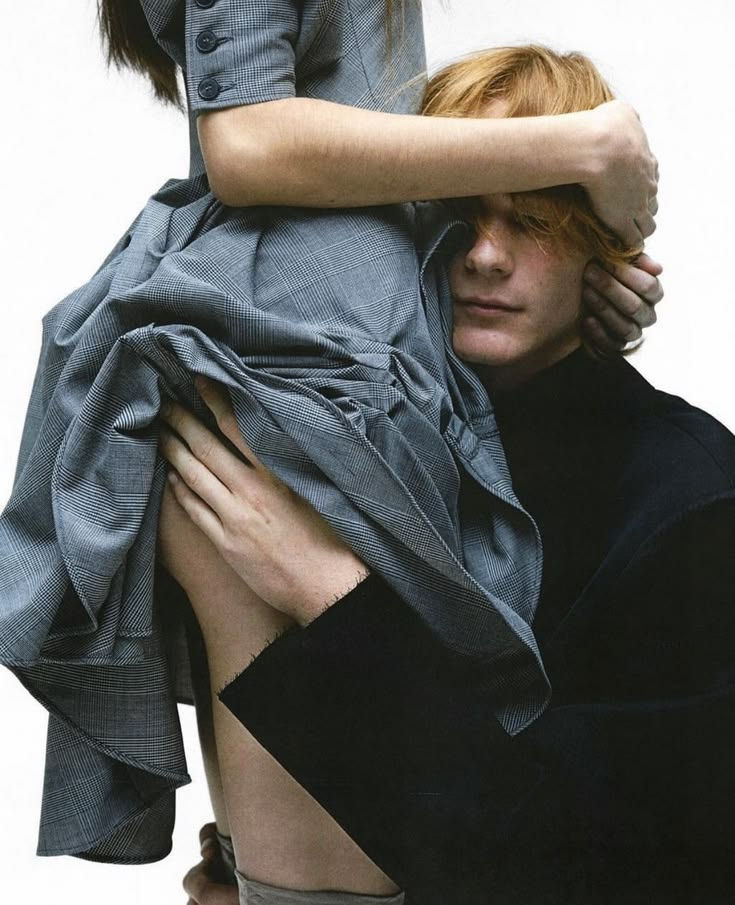
Photo © Photography by Alasdair McLellan for Vogue Paris 2018 / Photography by Zhong Lin



Comments