


.png)
The Beauty Industry Doesn’t Want You Beautiful. It Wants You Insecure.
When I was a child, a dog bite left a scar across my entire face. Significant enough that a plastic surgeon had to be called in to save my eye. Significant enough that the cutest boy in class would awkwardly flirt with me loudly on the bus by calling me Scarface.
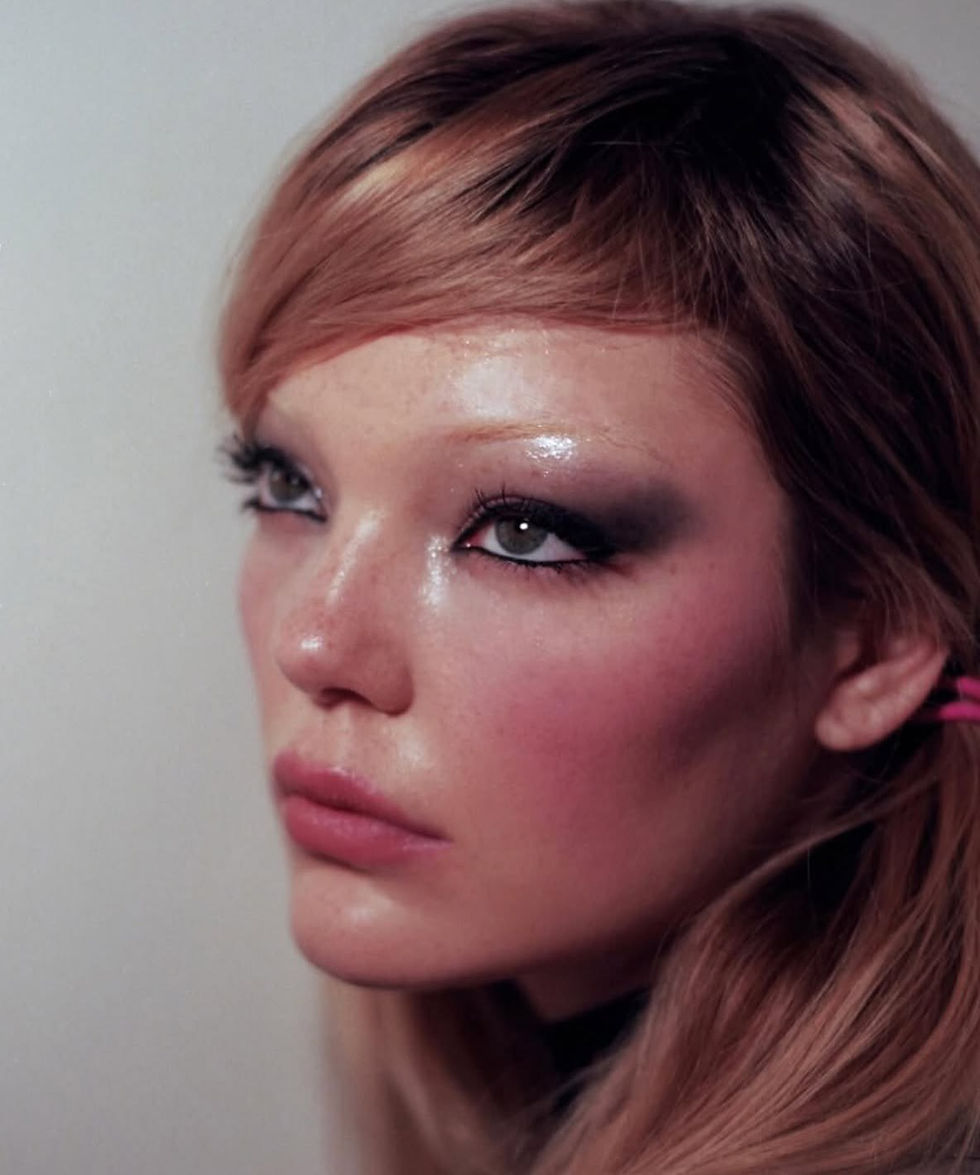
Statement pieces, as I grew older, were my sleight of hand. A face I'd learned to downplay, consciously upstaged by sequins and bold patterns.
As I grew up, more plastic surgery was always an option on the table. My grandfather was a doctor, and when my parents offered me old-school medical dermabrasion, trying to erase the experience, he gave me the most honest informed consent: “One third, it could come out looking better. One third, the same. And one third, worse.” The unhinged act of sanding the skin from your face is a constant across all three outcomes.
I turned it down. I didn't have the language for it yet. Just the instinct. I'm assuming Jennifer Grey, the actress everyone knew from Dirty Dancing, didn't have that conversation with anyone. When she went under, surely nobody told her that one third of the time, you could come out looking like someone you no longer recognise. That the ineffable thing that made her magnetic, the je ne sais quoi that casting directors and audiences chased, could be the precise thing a surgical correction erases. She didn't know what she didn't know: that she completely overrode her own nature.
The whole beauty industry runs on the premise that nature makes mistakes, so it tries to reinvent, to create, in a lab, a more potent formula that gets to skip the natural line and slip through the back door.
We've confused information with knowledge. Information is what the industry sells you in fragments, and more of it just gives you more surface area to doubt yourself against.
The beauty industry has always known that women want radiance, vitality, the kind of glow that reads as deeply alive. What it has never offered is the actual mechanism that produces it. So it meets that hunger with its oldest reflex: look outside yourself for another product, another protocol, another active compound severed from the living system and stripped of context.
The market is saturated beyond reason. We have never been more inundated with disjointed information about our ingredients, our skin, our procedures, our protocols. Has any of it made us feel more empowered? Or has it simply handed us more to scrutinise about ourselves?
I'd argue neither. We've been handed more beauty content than any generation in history and are starving for actual knowledge. It is water everywhere and not a drop to drink. More than a century of compartmentalising the human body, treating its systems as separate, fixable and optimisable in isolation, has produced an enormous body of industry data that we've collectively mistaken for truth. We've been humanSplaining nature herself with such confidence that we've forgotten to ask whether nature agrees. She doesn't.
We've repeated this fracturing for decades, breaking up with one bad boy just to find another with a different name but the exact same vibe. Green beauty splintered the industry into a hundred cleaner-sounding ingredients. Biohacking fractured the body further still, arriving with the vocabulary of science but the same reductive logic underneath. Looksmaxxing is only the latest fragment sold as the whole: twenty-year-olds on prejuvenation calendars, signalling molecules rerouted in the name of optimisation, your peers purchasing cheat codes and altering the playing field. The unspoken message is: keep up or age embarrassingly. And you feel it in your body before you can put a finger on it, a low static hum of not enough running under every mirror you pass.
Doesn't it feel like science is hoodwinking us? Did we take into account the ten-year effect of filler migration? Of chronic signal override? In the absence of real knowledge, we will always have to walk it back.
Take the sun. The industry told us it causes damage: cover up, block, watch for brown spots and melasma, it will age you. So we bargained. Reef-safe SPF. Staying out of noon light. We sprayed chemical particulates with wild abandon, then wondered why the system still wasn't working. In reality, oxidative stress is at the helm. Oxidation happens when your cells can't use oxygen properly, and that starts further upstream: light timing thrown off, key minerals out of balance.
The sun's rainbow of light, travelling from morning to night, doses out exactly what our ancestors evolved to receive, like a vitamin timed to the day. Thirty years of disconnection from it was sold back to us as good, measured youth preservation. Forget biological arbitrage. Circadian timing is the real GOAT. The moment light enters your eyes in the morning, it begins calibrating everything downstream: hormones, energy balance and cellular repair. Solar codes that have barely entered the beauty conversation.
Consider retinol. Vitamin A in its whole form is found in liver, egg yolks, tallow, butter, the things our grandmothers ate without calling it a protocol. Nature delivers it in context, with its cofactors, at concentrations the body recognises.
What you know as retinol is the line jumper: a lab-made isolate of vitamin A, amplified to levels nothing in the wild produces, then sold back to you as a breakthrough, unnaturally forcing the cellular turnover we now call glass skin. Pregnancy doctors flag it as dangerous while the whole source gets dismissed.
We reverse-engineered the whole into a fragment and now argue about it as though that were what nature intended. Nature doesn't cook like that.
At a restaurant on the Amalfi Coast, you could order the best caprese of your life. Three ingredients. No intervention. Or you could order the 20x results-driven, lab-optimised simulation of that experience. There are no wrong answers, only consequences, and the difference between a result and a bad idea is often just time.
When I say knowledge, I'm speaking gestalt: understanding fundamentally that you are a divine system acting within a divine system.
I spent two decades in atelier fashion learning that a garment constructed with integrity behaves differently on the body than one assembled from shortcuts. Proportion, technique, the threading and interfacing of materials that give a structure its support: this is science as much as craft. The same principles that determine why a structure holds, why the right material transforms everything it touches, why support applied at the correct layer changes the behaviour of everything above it, those principles govern the body too. Beauty, at its root, is applied biology. Bio-individuality is biological couture. The destination is rhythmic coherence with nature, but the path back is entirely bespoke. I simply changed the material I was studying.
Being broadsided by illness forced that pivot. Wading through circular patterns of my own, my life depended on sorting the real threads from the noise. It was the couture of garment-making applied in systemic total to the couture of crafting wellness, one that applies equally to longevity and regeneration. Nobody had a definitive map for where I was. I studied the material. I studied myself. I saved my own life.
The beauty results were the side effect I didn't see coming. Knowledge was the glue.
Jennifer Grey was beautiful exactly how she was born, and she surgically altered it, the height of rejecting her own capacity for accepting the “it girl” she actually was. The nose job that landed her in the one third nobody warns you about.
Splintered information breeds anxiety, and anxiety is what leaves modern beauty grasping at everything and rooted in nothing. I know this because I cannot think clearly while I am solving for my own anxiety. Try picking out an outfit with anxiety running the show. Nothing gels. The in-sourcing of my beauty is based on the cultivation of my coherence.
My scar faded. No procedure, no product, no protocol. Skin regenerates. This is not a wellness claim, it is a biological fact. When you support yourself systemically, you are in a constant state of renewal. As I grew up, I grew out of it. Form followed function, the inner landscape produced the outer result. Nobody puts Baby in a corner.
My skincare routine is lo-fi. Built around the approach an eleven-year-old in the '90s takes: skincare for the pure experience of it, the ritual in its simplest sense. Before TikTok. Just before self-doubt takes over. When products weren't yet being begged to fix everything. To find the joy of ingredients in their whole form, to steep in a scent combination that smells like the Los Angeles landscape after it rains in autumn. We were designed to heal a cut, mend a bone, deploy our own endogenous peptides. Stop outsourcing what was always yours.
The exalted, harmonised self still gets to indulge in beauty in a bottle, in proper measure.
Deep down, your intuition already knows that nature loves simple, perfect order. We are as much a system as a forest or a tidal sequence, native to that intelligence, woven into it. Remember that, and something shifts that no product stack ever could.
Real knowledge makes you dangerously, authentically beautiful. The most potent beauty product has no ingredient deck, no jar, no delivery system engineered to penetrate the dermis. It is the knowledge of how your body was designed to work and the practice of living in rhythm with it. It predates every brand and trend cycle the industry has declared and left behind. It is the intelligence already inside you, organised by light, attuned to season, waiting to be remembered.
Nature is unbearably beautiful, and what we call a flaw is often just her refusing to repeat herself. Homogenise enough of us chasing the same standard, and individuality goes extinct right along with it. The work is remembrance. The reward is radiance: the natural signature of a body that is fully, coherently alive.
Photo © Malia Sine for Polyester photographed by Lewis Vorn


Comments