


.png)
The Person Online is Real, But She is Not The Whole Story.
I find it a hard line to tread: navigating the persona I have created on social media alongside that of my regular corporate job. In both worlds, I have always been quite good at being guarded. I share online in much the same way that I would with colleagues: a little insight, but nothing too revealing; nothing overly emotional; surface-level, with a sprinkle of humour. The perfect recipe for almost all work-based relationships.
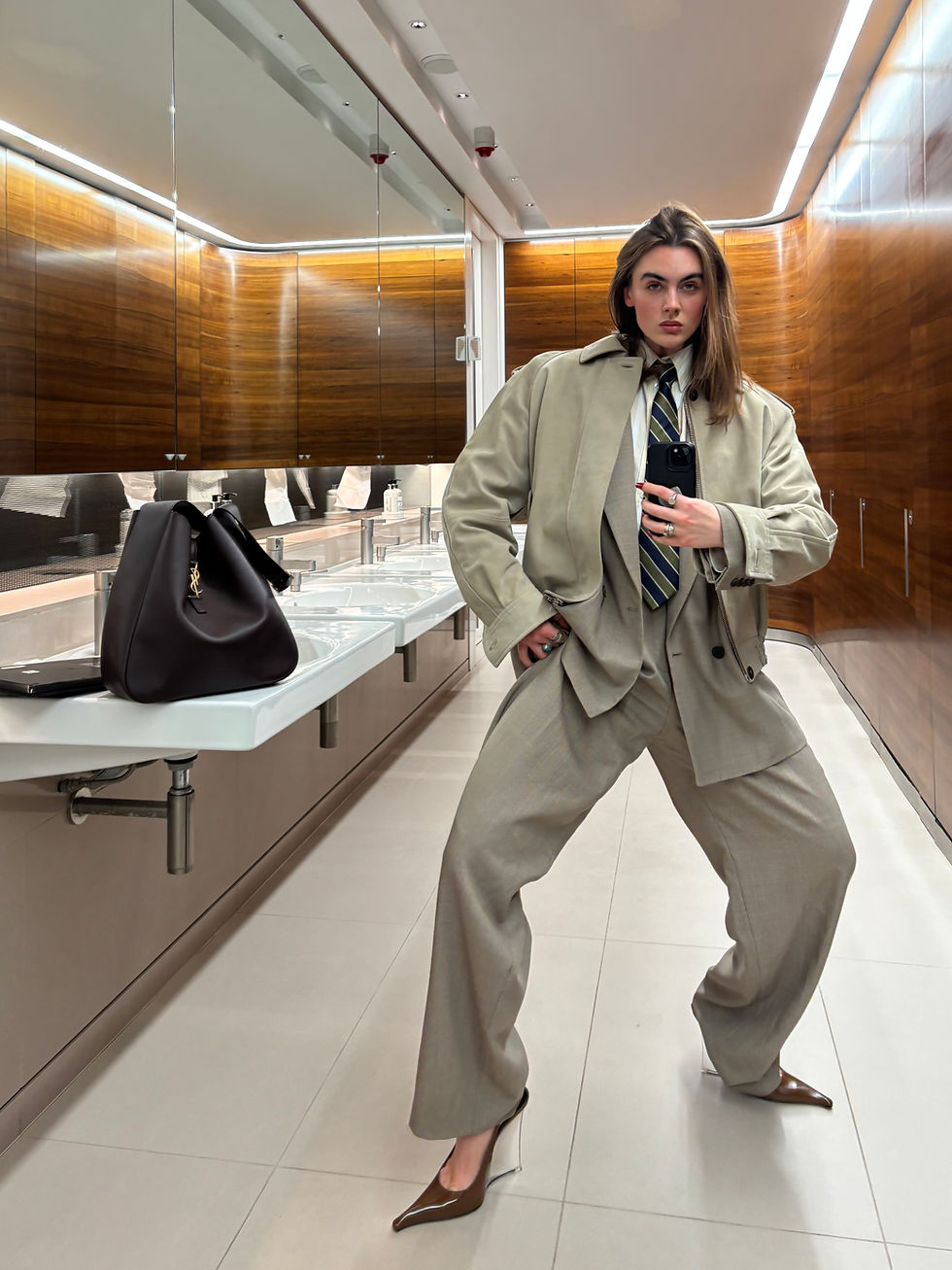
It is a strange kind of intimacy. Enough information to create the impression of knowing someone, but never enough to make either party uncomfortable. Both my corporate life and my online life require a certain degree of polish. Both reward confidence. Both benefit from knowing what to reveal and, perhaps more importantly, what to leave unsaid.
And then, in July, my personal life changed quite dramatically.
My relationship ended suddenly. I won't go into the details here. Not because there isn't a story, but because there is a difference between being honest and being entirely exposed.
What matters for this essay is what happened afterwards.
Twenty-four hours earlier, I had woken up next to someone imagining my future with him. We had talked about marriage and children, where we might eventually live, even which places were slightly too far a commute into London. For the first time, these things didn't feel like abstract ideas belonging somewhere in the distant future. They felt tangible.
It felt right.
And then, overnight, that future disappeared.
There is something particularly disorientating about losing something you had come to believe in so completely. You are not only grieving what has happened; you are grieving the version of your life you had already started to imagine.
Perhaps that is why heartbreak has so often been given the language of mourning. I had always thought that comparison was somewhat melodramatic.
I don't anymore.
Grief is remarkably physical. It changes the way you sleep, eat, dress and move through the day. Things that would ordinarily feel important suddenly don't. Things that would ordinarily be easy suddenly require an extraordinary amount of effort.
And, rather inconveniently, I still had social media.
There is something faintly absurd about being heartbroken in 2026. The nineteenth-century heroine could retreat to the drawing room, wander the moors, write feverish letters and become increasingly unhinged in private. I have notifications.
There is content to post and engagement to maintain. A feed that, unlike a grieving person, does not stop.
Emily Brontë gave Catherine Earnshaw the moors. Dickens gave Miss Havisham her stopped clocks and decaying wedding feast. Shakespeare gave Hamlet a skull.
I have social media.
Perhaps this is the modern equivalent of the haunted house: a place where the past remains permanently visible, except now the ghosts are algorithmically resurfaced.
And I found myself desperately not wanting to play my part.
I didn't want to think about followers or engagement. I didn't want to make content. I didn't particularly want to perform being fine. But I felt an obligation to continue because I had created a persona, and personas have a peculiar quality: once other people become accustomed to them, they begin to feel like obligations.
Social media had become accustomed to a certain version of me. Fashion, work, clothes, opinions, a little humour, a little finance; a life that, from the outside, appeared busy and interesting and, crucially, intact.
So I continued.
Social media saw me do a deep dive on Community. That day, I was packing my things into boxes.
Social media saw me dissect John Galliano's exhibition at the Met. That day, I was moving those same boxes into a new flat.

Both things were true.
That is the part I find most difficult to explain. I wasn't lying. The person discussing Community was me. The person carrying boxes into an unfamiliar flat was also me. The person dissecting Galliano was me. The person privately trying to make sense of what had happened was me.
They were simply different parts of the same life.
Perhaps this is what social media has misunderstood about authenticity.
We tend to think the opposite of authenticity is dishonesty. But it isn't necessarily. Sometimes it is omission. Sometimes it is simply the decision to show one room of the house and leave the others locked.
And perhaps that is what we all do.
We photograph the dinner, not everything that happened before or after it. The promotion, not the months of wondering whether we are good enough. The outfit, not the existential crisis that preceded getting dressed. The finished product, never the debris.
Social media is therefore not necessarily a collection of lies.
It is a collection of selections.
And selection can be almost as powerful as fabrication.
We are all editors of our own mythology.
This is not particularly new. People have been constructing versions of themselves for centuries. Samuel Pepys recorded his life with extraordinary intimacy, but even a diary is a kind of performance. Oscar Wilde understood perhaps better than most that identity itself could become an aesthetic project: life as performance, the self as something consciously composed.
Then there are the literary characters who become trapped inside the identities they have constructed.
Dorian Gray preserves the appearance of youth and beauty while the reality of his life deteriorates elsewhere. Miss Havisham allows one moment of her life to become the organising principle of every subsequent one. Her wedding dress becomes a costume, her house a mausoleum and her grief an identity.
Catherine Earnshaw seems unable to separate herself from the emotional landscape of her past. “I am Heathcliff” is perhaps one of literature's most extreme expressions of the collapse between self and other.
These characters are fictional, obviously. But there is something recognisable in them.
We are all capable of turning experiences into identities: the successful one, the funny one, the independent one, the stylish one, the ambitious one, the person who always has somewhere to be, the person who is fine.

Social media makes this process unusually visible because we leave behind a permanent archive of the person we have decided to be.
Which raises an uncomfortable question: what happens when your real life no longer matches the character?
I think that is what I have been struggling with.
I had become very good at presenting a coherent version of myself. Then my actual life became profoundly incoherent. And still, I felt obliged to post.
There is something almost comical about the contrast. My private life had entered the territory of nineteenth-century tragedy while my public life continued to operate on a content calendar. The algorithm did not know I was grieving. And, more importantly, it did not care.
The feed moves on.
That is perhaps one of the strangest things about our contemporary lives. Our technology has become extraordinarily good at preserving appearances while remaining completely indifferent to circumstances. You can be navigating an enormous personal upheaval and still be thinking about whether a photograph has enough engagement.
You can be grieving one life while maintaining the appearance of another.
And perhaps this is why the language of the “highlight reel” has always felt slightly insufficient to me.
The problem isn't simply that we see everyone else's best moments. The deeper problem is that we can begin to believe that those moments constitute the person.
We mistake evidence of a life for the life itself.
A photograph of someone in a beautiful restaurant tells us that, at one particular moment, they were in a beautiful restaurant. It tells us almost nothing about whether they were happy.
A photograph of professional success tells us something about the outcome. It tells us very little about the cost.
And perhaps the same is true of me.
The person you see online is real. But she is not the whole story.
She is a character I have constructed from genuine pieces of myself: the clothes, the humour, the work, the opinions, the ambition.
But she is still a character.
Perhaps I am finally beginning to understand the strange psychological cost of maintaining one.
Because the problem with creating a persona is that eventually other people believe in her.
And then, sometimes, so do you.
Until something happens that the character was never designed to accommodate.

Heartbreak is not particularly Instagrammable. Grief doesn't have a good hook. There is no aesthetically pleasing carousel for discovering that the future you thought you were building has suddenly changed.
And perhaps that is the point.
We don't owe social media the whole story.
Authenticity does not require complete disclosure. Privacy is not dishonesty. Boundaries are not deception. But there is a difference between choosing privacy and feeling imprisoned by your own presentation of yourself.
I am still trying to discern where that line sits. Perhaps I always will.
For now, I am still posting. Still working. Still talking about clothes and fashion and culture. Still injecting humour. Still, occasionally, presenting the version of myself that social media has become accustomed to seeing.
But I have become much more conscious of what that version is: not a lie, not a fabrication, but a selection.
A life can look completely intact from the outside while being entirely different on the inside. And perhaps that is all social media ever was.
Not the whole picture. Just one frame.
Photo © Kat From Finance via Instagram (@katfromfinance)


Comments