


Café Deco Believes in the Power of Keeping Things Simple
In a London dining culture obsessed with spectacle, Café Deco is making a case for something quieter: food with conviction, hospitality with warmth, and the confidence to stop when something is already good.

There is something almost unconventional about a restaurant that does not seem particularly interested in proving anything.
Café Deco, set on Store Street in Bloomsbury, is a restaurant, bar and wine shop built around a deceptively simple idea: cook good food, buy beautiful produce, pour good wine, look after people, and know when to leave well enough alone.
In an era when restaurants increasingly arrive with elaborate concepts, highly engineered interiors and plates seemingly designed with the camera in mind, Café Deco feels almost stubbornly assured in its simplicity.
That was not necessarily the point when Anna Tobias first imagined it. She was not trying to answer the question of what London’s restaurants were missing. She was thinking much more personally.
“When I was thinking about opening Café Deco, I wasn't so much thinking about what restaurants London needed,” she says. “What was more important to me was opening a restaurant that I fully believed in.”That conviction became the foundation of the restaurant.
The cooking is simple, produce-led and rooted in classical styles, with a particular leaning towards Eastern Europe. There is no desire to constantly reinvent familiar dishes simply because reinvention is what the moment seems to demand. Instead, Café Deco looks towards the confidence found in traditional European cooking, where a dish can be allowed to remain exactly what it is.
Anna traces part of that philosophy to travelling through Europe.
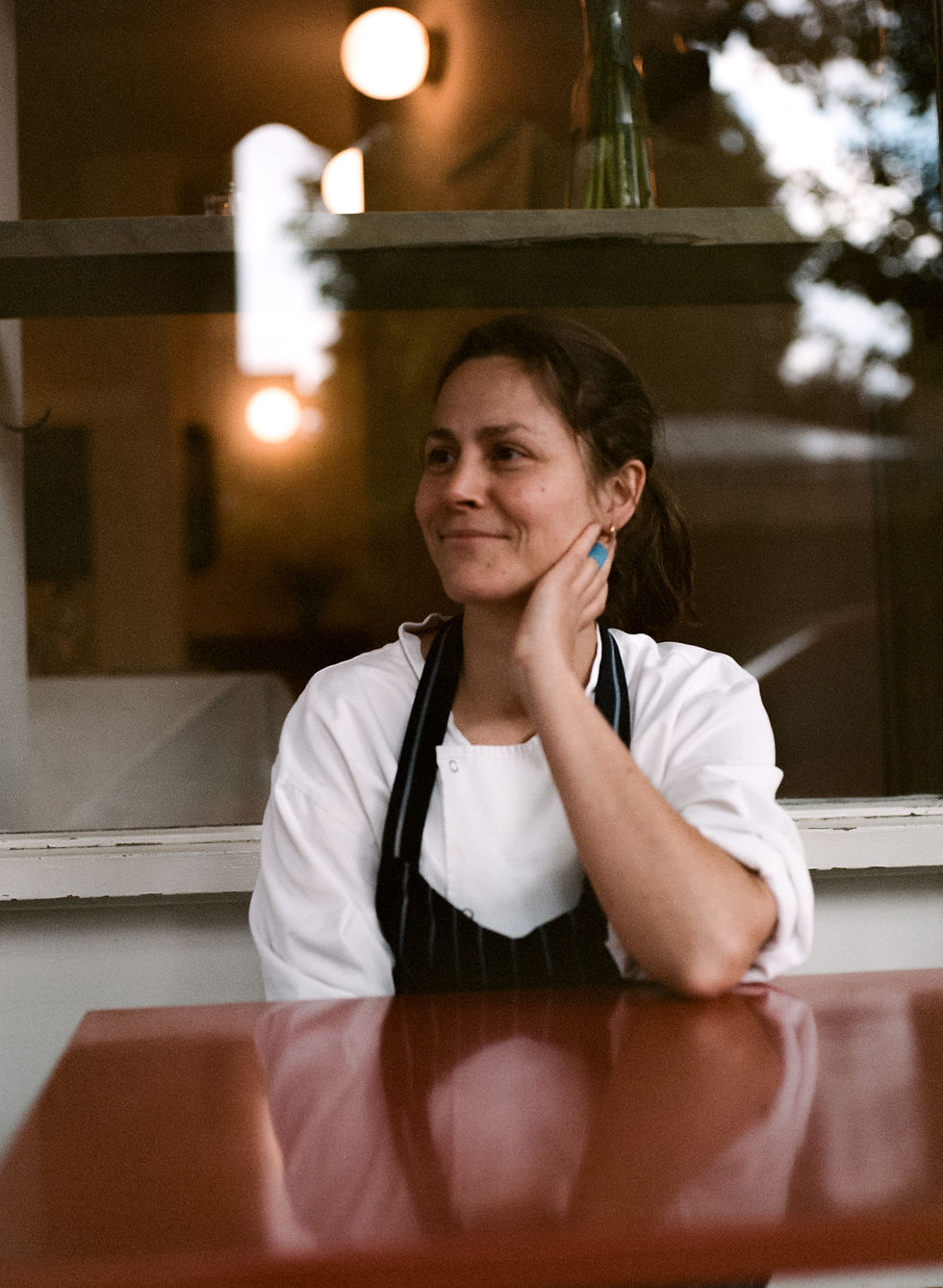
In Italy, Greece and Austria, she noticed something that stayed with her: a quiet confidence in traditional food. Classic dishes did not seem to need updating, decorating or explaining. They could simply exist on their own terms.
“There’s a kind of satisfaction and peace in that,” she says.It is a deceptively powerful observation. Because what if the most difficult thing in hospitality now is not knowing how to add something, but knowing when not to.
At Café Deco, that principle has become almost an obsession.
“We strive for extreme simplicity,” Anna says. “We're trying to get the best out of a product by doing as little to it as possible.”The ingredient is helped as much as it needs to be, and then the kitchen stops.
There is a temptation, particularly in modern food culture, to confuse beauty with embellishment. A plate can always have another element, another texture, another garnish, another detail designed to make it photograph slightly better. Anna's approach is more disciplined. If parsley does not actually improve the dish, why put it there?
Even if the resulting plate happens to be brown or beige, so be it. - There is confidence in that restraint, and it extends beyond the food.
Café Deco was born during COVID, opening at a moment when the future of hospitality was almost impossible to predict. For its first six months, it operated as a deli because restaurants were not allowed to serve people in the usual way.
The uncertainty left a permanent mark.
Anna became intensely conscious of waste, cost and responsibility. The oven is turned off between shifts. Scrap paper is avoided. Blank sides of invoices become draft menus. Food waste is treated not only as a financial problem but as a matter of respect towards the farmers producing the ingredients.
The experience also changed the way she thought about responsibility towards the people working around her. Because the restaurant opened at such an unfortunate moment, some employees did not qualify for furlough, leaving Anna with a profound sense of responsibility for a team she could not protect in the way she wanted.
It is one of the less glamorous parts of running a restaurant, but perhaps one of the most revealing.
Café Deco’s philosophy is not only about what appears on the plate. It is about how the entire place operates. That extends to the wine.
Wine is not treated as an accessory to the food, but as an equal part of the experience. The restaurant is also a wine shop and bar, and its partnership with the team behind 40 Maltby Street made that emphasis feel natural. Anna had known the team for years, having worked occasional shifts there while freelancing, and the partnership grew from an existing friendship and shared understanding rather than a carefully engineered business arrangement.
The wine itself follows the same principles as the kitchen. Café Deco works with natural wine and pays close attention to how the food and wine it buys are produced, particularly farming practices and the avoidance of pesticides and herbicides.
But there is no need to turn that philosophy into a billboard. The wine is simply there, doing what wine does best: making dinner feel more complete.
And perhaps that is the point of Café Deco as a whole. Nothing is shouting for attention. Even the space follows the same logic.
Anna worked closely with architects Caswell Bank and Michael Marriott to create a restaurant that felt distinctly European without becoming a reproduction of somewhere else. Recycled materials and second-hand wood give the interiors their patina, while the space avoids the polished sameness of a restaurant designed from a template.

But when Anna talks about what makes a restaurant beautiful, she does not begin with the architecture. She talks about service.
“You'll go back to a restaurant because you enjoyed the atmosphere, the service, and the way it made you feel even more than the food,” she says.It is an unexpectedly old-fashioned idea, and perhaps that is exactly why it feels fresh.
Café Deco wants people to feel comfortable, safe and looked after. The food matters enormously, but so does the experience surrounding it. And Bloomsbury is an unusually fitting place for that philosophy.
The neighbourhood brings together publishers, writers, galleries, universities and the Architectural Association, creating a clientele that naturally reflects the intellectual and creative character of the area. Writers and publishers come in for lunch. People from the art world have begun appearing as more galleries open nearby. University lecturers drift in from the surrounding institutions.
The restaurant is central enough to be accessible from all directions of London, but it still has a distinct local identity.
That mixture seems to matter to Anna. From the beginning, she wanted Café Deco to feel welcoming to everyone. Not exclusive. Not intimidating. Not somewhere you need to understand a particular vocabulary before you are allowed to enjoy yourself.

Just a restaurant, and a good one. And perhaps that is where Café Deco becomes more than a restaurant built around simplicity. It becomes a small argument for sincerity.
Anna is not interested in chasing whatever happens to be fashionable. She wants Café Deco to have a point of view strong enough that you can recognise its food even when you encounter a photograph of it without context.
She hopes that when someone visits for the first time, they leave understanding that the decisions made there are deliberate. That the simplicity is not a lack of ambition. It is the ambition. There is a difference between having nothing to add and choosing not to add anything.
The restaurant also understands something else: people rarely remember a meal only for the meal itself.
They remember who they were with. The conversation. The date. The birthday. The friend they had not seen in months. The afternoon they decided to eat alone. The table they always return to. The bottle of wine they discovered. The feeling they had when they walked through the door.
That is how a restaurant becomes part of someone's life. Not through spectacle, but repetition. Through familiarity. Through the small rituals that accumulate until a place becomes attached to particular people and particular memories.
In that sense, Café Deco is not really arguing against beauty, creativity or modernity. It is simply refusing to confuse them with excess.
The food can be beautiful without being precious. The room can be beautiful without being theatrical. The wine can be important without becoming a lecture. The service can be polished without losing its warmth.
And the restaurant can have a strong identity without constantly announcing what that identity is. Perhaps that is the quiet confidence at the heart of Café Deco.
In a culture that is forever asking what comes next, it is perfectly content to ask a different question: What if what we already have is good enough? We cared enough to get it right.
Photo © Photography by @cafe_deco_bloomsbury


Comments